












Sinus Problems and Allergies: The Household Connection
It's hard to find someone who has never had a sinus issue, like sinus pressure. In fact, this a common ailment that affects millions at home and abroad. Yet in most cases it can be dealt with successfully. Allergies to the environment is the root of some forms of sinus pressure and other sinus problems. So we are going to show you how to find out whether those kind of allergies are, indeed, the main cause of your sinus pressure or other sinus issues and what to do if they are. If allergy to the household environment is not the cause we will also offer also some suggestions as to what you could do to alleviate your sinus problem.
Invisible household culprit
A very common cause of sinus pressure and other sinus issues is house dust. Most of it is made up of dead skin we shed every day as we walk, dress, eat, watch television, etc. There are many types of house dust. Technically, however, it is not the house dust per se that is the problem, but additional elements in it. For example, if you have pets--especially a cat or dog, or both--your household dust is going to be different than mine, one who does not own any. Animal dander in the dust is a major allergen for many people. There is a house dust dweller whose droppings can cause havoc in many a person's sinuses cavities, I am one of them, hence my aversion to it. This little rascal is the dust mite. They are extremely small and difficult to eradicate, so save your pesticide. Before we get too involved with those little rascals you need to find out whether you are, indeed, allergic to the nuisance's droppings. Do this, get real close to the carpet, mattress, and breath in some of the dust and see what happens. Depending on how allergic you may be to it, the reaction can be almost instantaneous and can vary in intensity. If after several minutes you don't feel any negative reaction, you most likely do not have an allergy to house dust. If, on the other hand, you do you would know it. For you would get right away, in most cases, one or more of the following reactions: a watery, clear or very light yellow mucus accumulating in the nose, itching in your nose, eyes, or face; a sensation of nasal or sinus pressure, coughing, congestion swelling of the nasal membranes, sneezing, difficulty breathing, sinus drainage. There may be other symptoms, but those listed are the typical ones. Inasmuch as a combination of warmth from body heat, and humidity from body perspiration, creates an ideal breeding ground for those little varmints,a mattresses is something you want to target if you discover you are allergic to house dust.
Household plants and flowers
Perhaps one of the reasons artificial household plants and flowers are so popular, besides not needing watering, etc., is the fact that they are innocuous to the allergy sufferer. The pollen of many beautiful real household plants is a pretty potent stuff for many people with allergies which can reflect a sinus pressure or other sinus or nasal cavity issues. We know a wonderful elderly lady who loves to give away live plants for many a good reason. She can afford it, so why not be nice and give away those beautiful living things to cheer up someone. Problem is that after a day or two you may begin to sneeze, or feel that something around is bothering you. So, if you think you may be allergic to some living plant, flower, etc in or outside and around the house--especially if your bedroom window is not far away from the outside beauties--get real close to them and, as in the case with house dust, take a good sniff and see what happens.
Household chemicals
One thing good housekeepers love is a good chemical to clean the ring on and around the bathtub. Or the new washing detergent with some exotic named ingredient that really gets the cloths clean and smelling good, or some other chemical component of a cleanser used around the house. The problem is that some of those modern chemical conveniences may contain an ingredient to which you may be very allergic. For example, ammonia, bleach, scents, disinfectants, detergents, etc. Again don't be afraid to experiment. You know now what simple steps you can take to let you know whether you are allergic to things in your immediate environment. In the case of household cleansers, etc., you may add a second step: Becoming in deliberate contact with the stuff and see what happens to your skin, breathing, etc. If you experiment nasal or sinus pressure or other breathing discomfort, as already described, above, for dust then you know you are possibly allergic to that substance.
What to do
- Eliminate the culprit. This is probably the least expensive and practical way to deal with the issue. In the case of animal dander the problem could be that the animal is so much loved by family members that you may end up having to move to a motel or apartment while the doggy keeps its choice spot in the house, shedding all that dander--assuming dander is the allergen causing the nasal or sinus pressure or any other breathing discomfort bothering you. Not the best solution
- Go see an allergy specialist and have some skin allergy tests made to determine for sure how badly you are allergic to the item you suspect. If your allergy is intense to animal dander and the doggy or kitty can't be given away, then get allergy shots for the dander. If the problem is with dust mite droppings in the mattress or carpet the allergy specialist has a protocol to deal with it
- You decided that the allergens you detected are not bad enough to warrant any of the above alternatives. Then do the best to avoid coming in close contact with the item and take, in some cases, an OTC remedy to ease the discomfort when it gets to be too annoying
. For example:
- Benadryl
- Antihistamine, like loratadine (Claritin)
- Any other popular decongestant or medication your doctor or pharmacist suggests
- If you got close to the carpet, the mattress, the plants and flowers and there was no allergic reaction, then check the kind of foods you eat. There are some foods which can produce sinus pressure or other sinus symptoms
- Do not let sinus pressure build up and do nothing since it could lead to a sinus infection. In such cases a sinus pressure points procedure (acupressure) is very helpful to drain the sinuses.
With some insights as to how to deal with allergic reactions to your household environment, you may be able to eliminate or significantly reduce their annoying impact. Whether it be nasal or sinus pressure or some other respiratory discomfort.
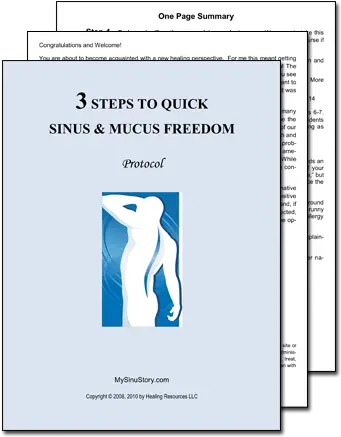
The Best 3 Sinus Healing Systems:
Natural Medicine · Food · Acupressure
Combined Into One Fast-Acting
Simple
Protocol
It Works!
Unsolicited testimonials can't be wrong
Testimonials
- You are right on M. S., Md
- It really works . . . Thank you R. L., P. B., Fl
- 3 Steps to Quick Sinus & Mucus Freedom is the right thing R.D., Cusi, Fr
- I found your publication very helpful Springfield, Va
- This article really helped me, thank you so much! A.U.
- Your advise has been quite helpful, less pain M. C.
- 3 Steps to Quick Sinus & Mucus Freedom is working well K. M., L. A.
- [the publication] was quite helpful S. K., India
- My sinuses are much better. Glad I followed 3 Steps. Tks. E. W., Memp.
- The [healing herb] really helps R. L., P. B., Fl
- Amazed with reasearch. Magnificent! N. K., Forum
- It's amazing to think how many doctors, medications, and tests I've gone through in the last three years . . . your information was by far the most helpful yet! Thanks again. G. W., Parma Hts., Ohio
To Order
&
Instant eMailing
Use Any Major Credit Card
PayPal™
Will Process Your Order
For Best Secure Payment
and Protection

Only $19
If you prefer you can send a Check or Money Order
for $26.95 (overseas postal mailing US $29.95)
and I will send it by First Class Mail

